
Delivering the NHS Medium‑Term Planning Framework (MTPF)

4 min read
(March 2026)
Delivering the NHS Medium‑Term Planning Framework (MTPF)
3:43

A Whitepaper on Integrated Multi‑Year Budgeting, Costing and Income


1. Executive Summary

The NHS is entering a period of significant change in its financial and operational planning approach. The Medium‑Term Planning Framework (MTPF) for 2026/27–2028/29 introduces requirements for multi‑year planning, credible forecasting and integrated operational–financial modelling. These changes move the service away from annual budgeting cycles towards a more strategic, long‑term model.

This whitepaper summarises:

  • the current state of NHS planning processes
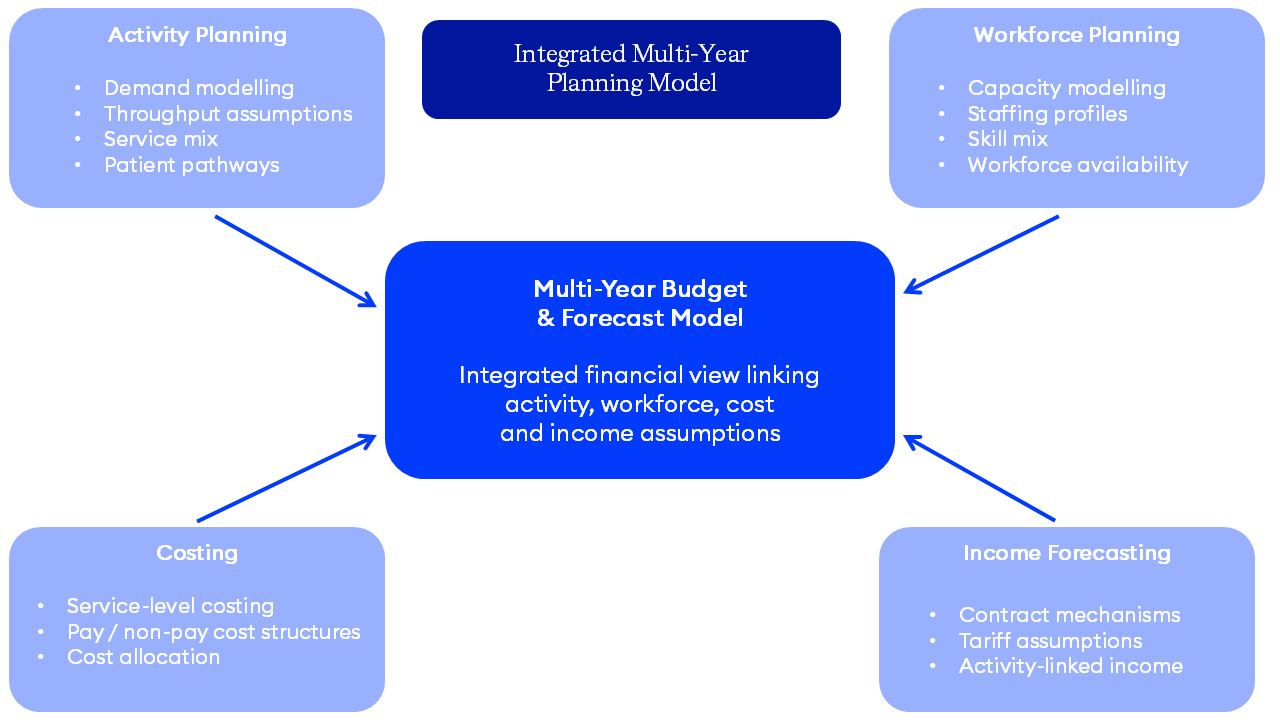
  • the structural changes required under the MTPF and a conceptual model for integrated multi‑year planning
  • the gaps between today’s methods and future requirements
  • a factual breakdown of what credible forecasting entails
  • illustrative examples demonstrating multi‑year planning effects

The aim is to provide an analytical view of the evolving planning landscape and outline the capabilities organisations will need to meet future expectations.

2. Current NHS Planning Landscape

Planning and budgeting practices across NHS organisations are predominantly shaped by annual cycles, local spreadsheet-based modelling and fragmented ownership of key planning assumptions. As a result, operational and financial plans are often produced in parallel rather than as a unified model.

Common characteristics of today’s environment

  • Planning cycles are typically structured around an annual timeframe
  • Local spreadsheet models are commonly used within divisions, services and cost centres
  • Assumptions are developed and maintained across multiple organisational levels
  • Activity, workforce and financial plans are often produced independently 
  • Operational updates and financial forecasts are refreshed on different timelines
  • Updates to planning assumptions are managed through locally defined processes throughout the year
Table (1)


3. MTPF Requirements (2026/27–2028/29)

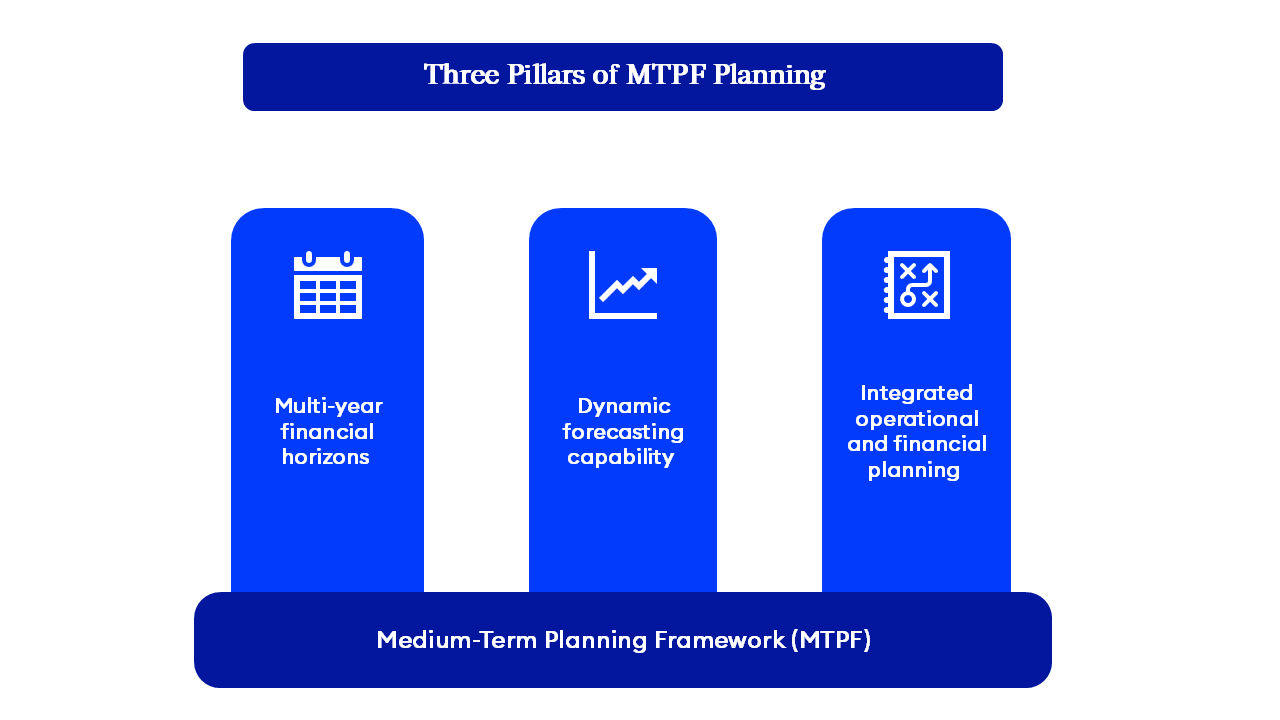
The MTPF sets out a different approach to medium-term planning, requiring organisations to shift from single-year plans to credible multi-year strategies.

Core expectations include:

  • Three- and five-year financial plans aligned with operational priorities
  • Forecasting that reflects current performance and expected trends
  • Integration of activity, workforce, cost and income assumptions
  • Alignment between Trust‑level and system‑level plans
  • Increased focus on transparency and traceability of planning assumptions
3 pillars

 
4. The New Required Process: Conceptual Model
Conceptual model 2


5. Gap Analysis: Today vs Required Future State 

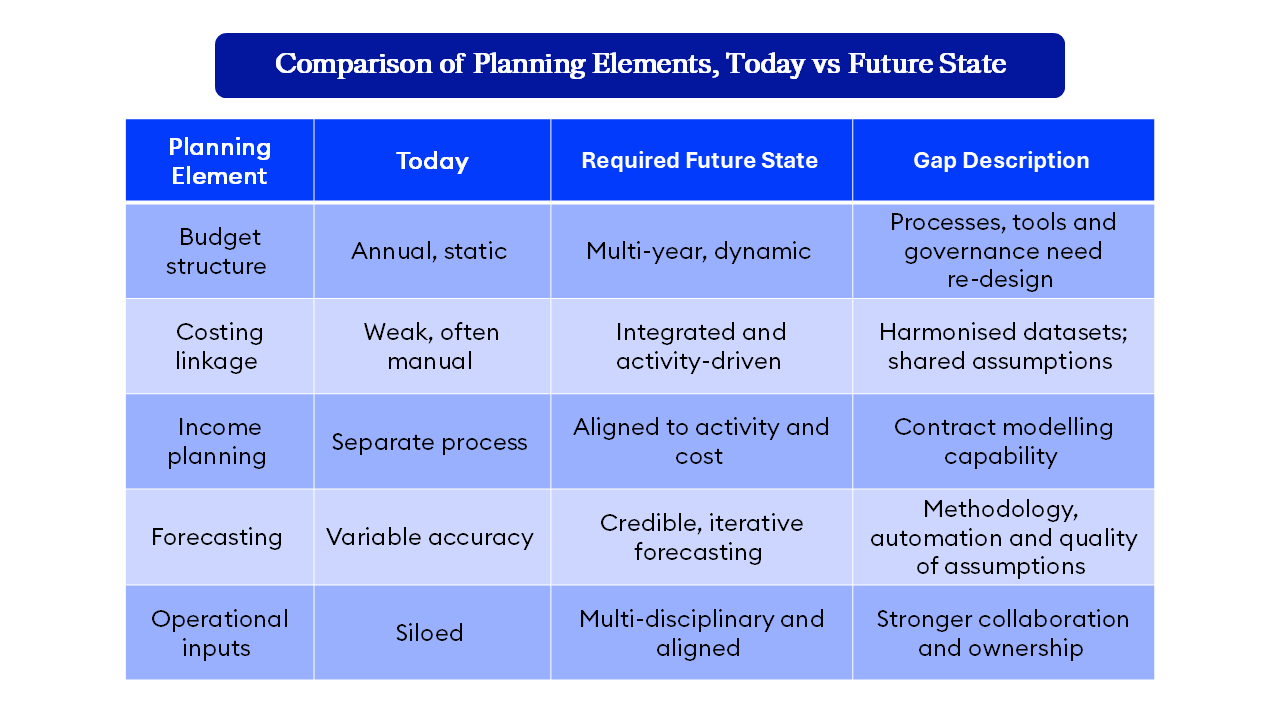
When planning out a new process that complies with the new requirements, it makes sense to compare what has been done to what needs to be done in a gap analysis. We have touched on some of the differences in a more implicit way already in the course of this whitepaper. The following table makes the analysis more explicit.  
Comparison table


Addressing these gaps will require not only improved processes, data foundations and governance, but also a meaningful cultural shift toward shared responsibility and closer collaboration across operational and financial teams.


6. What "Credible Forecasting" Looks Like

Credible forecasting is a core expectation across the MTPF.

NHS planning guidance emphasises that medium‑term plans must be evidence‑based, realistic and underpinned by clear triangulation between finance, activity, workforce and quality. Credible forecasting therefore requires a structured approach that links current performance to forward projections in a transparent and repeatable way.  
Key elements of credible forecasting according to NHS guidance: 

  • Regularly updated forecasts that reflect actual in‑year performance. 

  • Transparent assumptions that triangulate activity, workforce and cost, ensuring internal consistency across planning inputs.

  • Clear distinction between recurrent and non‑recurrent impacts. 

  • A traceable audit trail that records changes to assumptions and drivers. 

  • Structured scenario testing to understand the impact of emerging pressures and operational constraints. mentals, transformation becomes guesswork and grip becomes impossible.

7. Case‑Agnostic Examples  

To make this theoretical framework more tangible, we are taking a look at a few examples that illustrate it in a concrete manner. 

Scenario A: Activity Growth 

  • Activity increases by 4% in Year 1. 

  • Workforce demand rises due to increased throughput requirements. 

  • Cost projections increase accordingly (pay, non‑pay, overhead allocation). 

  • Income projections change based on tariff assumptions and contract rules. 

  • Multi‑year model shows cumulative financial impact over three years. 

Scenario B: Workforce Shortage 

  • A shortage in specialist staff reduces elective capacity. 

  • Activity delivery falls below plan. 

  • Income linked to case volumes decreases. 

  • Cost base remains largely fixed. 

  • Medium‑term plan identifies growing structural deficit unless mitigations are applied. 

Scenario C: Inflationary Shock 

  • Non‑pay inflation exceeds assumptions by 2 percentage points. 

  • Cost base shifts materially. 

  • Organisations model compounding impact across the medium‑term horizon. 

  • Scenarios help determine required savings or service redesign. 


8. Moving from A to B: A Practical Path Forward 

Transitioning from today’s fragmented annual cycle to an integrated, multi‑year planning approach is a significant shift. While the benefits are clear, the difficulty lies in getting there.

Start with achievable steps

Organisations can begin by mapping current planning workflows to identify duplication, bottlenecks and inconsistent assumptions. Standardising structures and definitions strengthens alignment, while clearer ownership of assumptions improves governance. Focusing first on high‑risk or labour‑intensive processes helps build momentum.

Acknowledge the difficult areas

More substantial change is required around data integration, forecasting methodology and cultural habits. Moving from isolated spreadsheets to shared assumptions and consistent scenario testing requires new ways of working and stronger cross‑team collaboration. Recognising these challenges early helps set realistic expectations.

Support is available

External tooling and advisory expertise can accelerate progress. A key enabler of integrated, multi‑year planning is bringing all components of the process into a single software environment. Systems designed for this purpose should provide:

  • A single source of truth across activity, workforce, cost, income and financial assumptions
  • Detailed budgets and summary forecasts in the same place, removing the need for parallel models
  • Fast in‑year forecast updates without navigating multiple spreadsheets
  • Linkage between activity‑based budgeting and costing, enabled through integration with Costing systems
  • Integration of income assumptions with income modelling, reducing manual reconciliation
    (Note: The final two capabilities represent more advanced functionality and may be part of a longer‑term development path.)

LOGEX supports this approach through a secure, cloud‑based NHS budgeting and planning solution that creates triangulated, multi‑year budgets by integrating activity, workforce and financial planning into one auditable model. It links NHS activity, staffing and financial data, automates calculations, enables scenario management and provides a single source of truth to support AFPR submissions and medium‑term planning.

Making thoughtful choices now about software, processes and data foundations can prevent years of trial and error and support a smoother transition to integrated planning.

The rich text module offers editing options for multiple types of content, such as text formatting, images, links, CTAs, and more.

To explore how your organisation can strengthen its budgeting and forecasting capabilities, contact us for a planning readiness review. →


Screenshot 2025-03-11 151950

Get the latest insights, industry trends, and updates on how LOGEX is transforming healthcare with data-driven solutions.

Subscribe to Our Newsletter