
- Press Overview
-
ESPID 2026: New Insights into the Burden and Prevention of Paediatric RTIs
EADV 2026: Key Takeaways and Our Poster on Real-World Psoriasis Treatment Patterns
Every year, the European Academy of Dermatology and Venereology (EADV) Congress brings clinicians, researchers and industry experts together to discuss the latest developments in dermatology. While new therapies remain an important part of the conversation, this year's discussions extended far beyond treatment innovation alone.
Several discussions at EADV 2026 highlighted the growing role of healthcare data and real-world evidence (RWE) in addressing questions that are difficult to answer through clinical trials alone.
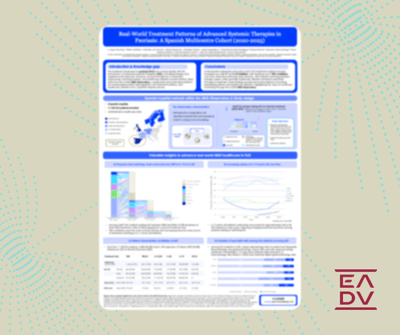
The LOGEX team contributed to these discussions by presenting a poster on real-world treatment patterns in psoriasis. A video walkthrough of the poster can be found at the end of this article.
Below are some of the themes that stood out during EADV 2026.
Hidradenitis suppurativa in the spotlight
Although EADV covers the full spectrum of dermatological conditions, hidradenitis suppurativa (HS) received significant attention this year. HS is a chronic inflammatory skin disease characterised by painful nodules, abscesses, and draining tunnels that typically occur in skin-fold aeras such as the armpits . This condition can lead to scarring, unfavorable odor, has a major impact on patient’s quality of life, and remains challenging to diagnose, monitor and manage.
Several sessions underscored that, despite an expanding treatment landscape, important questions remain around how best to assess disease activity, treatment effectiveness and long-term disease control. Researchers discussed the limitations of existing disease activity measures and the need for outcome measures that better reflect the patient experience, including pain, the impat of the odor, drainage and the broader impact of HS on quality of life. Discussions further emphasised the heterogeneous nature of HS and the importance of earlier diagnosis and intervention. Emerging approaches, including the increasing use of ultrasound, also reflected ongoing efforts to improve the objective assessment and monitoring of disease activity.
Together, these discussions reflected an ongoing need for more integrated insights into HS to better understand current approaches to diagnosis, disease assessment and management. Advancing this understanding may help clinicians identify patients earlier, assess disease activity more holistically, and make more informed and timely treatment decisions throughout the patient journey.
Better data for better decisions
Several presentations underscored the value of collecting more complete and consistent patient data.
As dermatology research continues to evolve and address increasingly complex clinical questions, researchers require access to richer and more connected data sources. Across multiple sessions, there was a growing recognition that diagnoses and treatment records alone are often insufficient to fully understand the complete patient journey. To better characterise disease burden, treatment effectiveness and long-term disease control, clinicians need insights into a broader, integrated range of variables, including comorbidities, smoking status, body mass index, previous treatment history and objective measures of disease activity.
This was closely linked to another recurrent theme: the importance of long-term and multidisciplinary follow-up. This is particularly relevant for chronic conditions, where disease activity, treatment response and patient outcomes can evolve over many years. As a result, longitudinal and integrated data are becoming increasingly important to understand disease progression, evaluate treatment strategies and support more informed clinical decision-making.
Towards more personalised care
Some of the discussions also pointed towards a more personalised approach to care.
Many of the conditions discussed at EADV, including psoriasis and HS, belong to the group of diseases of immune-mediated inflammatory diseases (IMIDs). These conditions are driven by dysregulated immune responses and are often associated with other inflammatory comorbidities.
As knowledge of these diseases continues to grow, it is becoming clearer that patients with the same diagnosis can differ in disease burden and progression, treatment response and long-term outcomes. This is driving a shift towards understanding patients more holistically rather than concentrating solely on disease symptoms. This was reflected in presentations addressing:
- identifying patients who may be at higher risk of disease progression;
- understanding the links between related inflammatory conditions;
- intervening earlier where appropriate to improve long-term outcomes.
The overall ambition is to better anticipate future patient needs and support care decisions that are tailored to the individual patient.
How real-world evidence can help answer these questions
Looking across these discussions, a common challenge becomes clear: many of today's most unanswered questions extend beyond the scope of clinical trials alone. While clinical trials remain essential for evaluating the efficacy of new therapies, understanding how diseases evolve and are managed in routine clinical practice requires additional sources of evidence
As the focus of the field shifts towards earlier intervention, more personalised care and more informed long-term disease control, understanding disease progression, comorbidities, treatment patterns and response, short- and long-term patient outcomes requires evidence from routine clinical practice. This is where real-world evidence (RWE) can play an important role, complementing clinical trial findings with broader insights from everyday healthcare settings.
Against this backdrop, we presented a poster on real-world treatment patterns in psoriasis: "Real-World Treatment Patterns of Advanced Systemic Therapies in Psoriasis: A Spanish Multicentre Cohort (2020–2025)" (Poster P2584). As treatment options for psoriasis continue to expand, understanding how therapies are used in routine clinical practice becomes increasingly important. Studies like these can provide valuable insight into how patients are treated over time and help address some of the broader evidence gaps identified throughout the congress and across the wider healthcare research landscape.
To explore these findings in more detail, take a look at our poster walkthrough below.
Get clarity and control to make better decisions.
Do you have any questions about harnessing data-driven insights for better financial analytics or seek advice? Allow our experts, such as Sarah, to lead the way.
They will reply within 48 hours on business days.